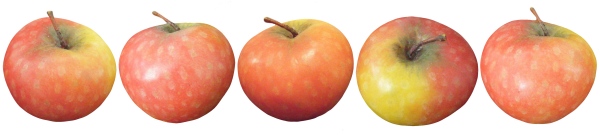
Fruit has exerted its miraculous, symbolic presence throughout the history of painting and poetry, from the golden apples of the Garden of the Hesperides, for example, to the “trompe-l’oeil” of Ewa Jakobs today. Hers are the sculpted fruit one would find in Spanish bodegas and 17th century Dutch conceits, with the meticulous perfection of their realism, and because they demonstrate, unpretentiously but unmistakably, the ephemeral nature of the world and everything in it.
First (and still) a painter, Ewa was one day swept by a desire to sculpt fruit – as a symbol of abundance, the promise of sublime earthly pleasure, of becoming, and to see and feel in its representations nature at its most intimate...Swept away also by a desire to mould the stuff of earth with her bare hands, to give it form in space, to make things emerge that break the bonds of earth, creating what she calls an airy, “aérien” reality.
In her native Poland, she discovered a secret process for modelling wax and paraffin using the heat of an open flame, and over time tweaked the recipe with her own experience and insights. Once the shape is set in flame and smoke, the “skin” is richly and delicately painted until the illusion is perfect.
True to her name (Ewa being Polish for “Eve”), she began by doing an apple – all kinds of apples, sharp fresh green ones from her childhood, red and green apples from nursery rhymes, shiny red apples like happy cheeks, apples in the style of Courbet, apples the crimson colour of spilled blood, chemical-free scabby apples ... Here’s to apples!
“I place an apple on my table. Then I put myself inside the apple. What peace!"
(Henri Michaux: "Magie”, Lointain intérieur)
(Henri Michaux: "Magie”, Lointain intérieur)
Ewa was then enthralled by other fruit to create a full range, a veritable market stall, richly diverse, from every season and continent, cherries and star fruit, pears and kiwanos, grapes and bergamots, with Mediterranean fruit taking pride of place: sprouted figs, melons, watermelons, lemons, discovering their secret architecture,
"Hard pomegranates sundered by the excess of your seeds"
(Paul Valéry, Charmes).
(Paul Valéry, Charmes).
She also fell in love with market gardens, with aubergines, peppers, squash, and the most seductive tomatoes... Ewa is always quick to spot the latest new arrivals on the market, and to feature her discoveries that may often be weird like "Buddha’s Hand” but are always unique.
Her wonders are a feast for the eye. Transcending their earthly roots, they speak of nostalgia, the Garden of Eden, the fragility of the moment connecting with our desire for eternity, while appreciating the everyday meaning of mould on a cut lemon or exploded pomegranate. They elegantly manifest the passage of time, precisely because their own lives have ended, hence the meaning of "still life”. So is this about fruit "as it really is"?
You can see Ewa Jakobs’ fruit collection at the Royal Castle in Warsaw, the Musée Nissim de Camondo in Paris, the Musée Hébert de La Tronche, at Gaasbeek Castle in Belgium, at Palais de Compiègne, at the National Museum of the Château of Versailles, which also now have sister collections in certain Paris boutiques, in particular "Au Débotté" 19 rue Saint Paul - 75004 Paris, (Saint Paul or Pont Marie metros).